
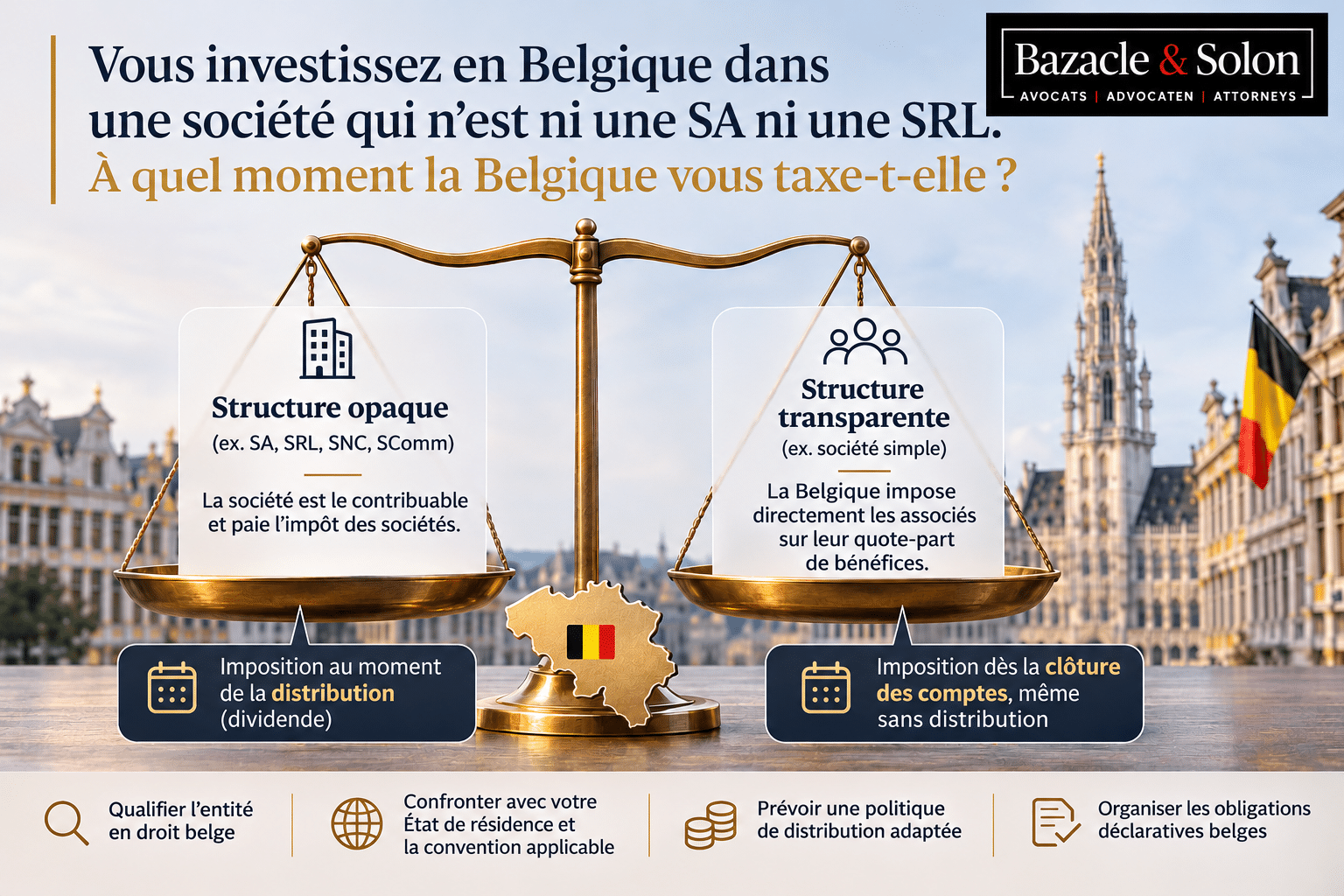
If you invest in a Belgian business, can Belgium tax you before it makes a distribution?
Suppose you live outside Belgium and invest in a Belgian business alongside a local partner. You expect Belgium to tax you only when you receive a dividend, by withholding tax at source. This is how it works for the great majority of Belgian companies, including SAs, SRLs, SCs, SNCs and SComms. Some structures, however, are transparent for Belgian tax purposes.
Belgium looks through these structures to their partners. It attributes a share of the profits to each partner, whether or not the profits are distributed. If you are considering an investment or deciding whether to distribute profits, the following points deserve attention.
Does Belgium look to the entity or to its partners?
The first question is whether Belgium treats the entity as a taxpayer in its own right or looks through it to the investors.
As a general rule, an entity with legal personality that carries on a business or other profit-making activities and has its place of management in Belgium is subject to Belgian corporate income tax. This covers the forms granted legal personality under the Belgian Code of Companies and Associations: the SA, SRL, SC, SNC and SComm. A partnership with partners who have unlimited liability is not automatically transparent.
Under Article 29 of the Belgian Income Tax Code 1992, the following are transparent:
- The simple partnership (société simple). Under the Code of Companies and Associations this is the only form of company without separate legal personality. It includes internal and temporary partnerships.
- Certain entities with legal personality that tax law treats in the same way as unincorporated associations:
- SNCs and SComms recognised as agricultural enterprises that have not opted for corporate income tax;
- European Economic Interest Groupings (EEIGs);
- under certain conditions, SNCs formed by converting a former economic interest grouping (GIE);
- associations of co-owners.
Legal form alone does not settle the issue. Any recognition, election for corporate income tax and the origin of the entity must also be checked.
Why classification matters
Classification determines who pays the tax: the entity, through Belgian corporate income tax, or its partners. For a non-resident partner, the applicable rates depend on whether the partner is an individual (progressive non-resident income tax rates) or a company (the corporate income tax rate).
It also determines when tax arises. Where an entity is opaque, earning profits does not trigger tax for its partners. They pay tax upon distribution. Where it is transparent, the partner is taxed on the allocated share of profits even if the entity retains them. The classification also determines the nature of the income and how the relevant double tax treaty applies.
Opaque entities: tax arises on the dividend
An entity subject to corporate income tax pays its own tax. You are taxed as a partner only when you receive a dividend. Belgium then levies withholding tax, generally at 30%. Depending on the treaty and your circumstances, the rate may be reduced to a lower rate or to zero. The outcome may depend on whether you are an individual or a company and on the size of your holding.
You have some control over timing: without a distribution, you do not receive a dividend. Many investors assume this applies to every structure, even where it does not.
Transparent entities: tax arises on your share of profits
Your allocated share, whether distributed or retained, is treated as your own business or professional income. There need be no distribution.
For a non-resident partner this has several consequences:
- A deemed Belgian establishment. Belgian law treats a non-resident partner as having an establishment in Belgium or as carrying on an activity there personally. In principle, you therefore fall within Belgian non-resident income tax. The applicable treaty may restrict Belgium’s taxing rights.
- A different category of income. Your share is business or professional income. Reduced treaty rates for dividends do not apply.
- Withholding at source. Professional withholding tax is due on your share. It is remitted by the tax representative appointed by the partners or, in the absence of such a representative, by the partners, who are jointly and severally liable.
- A tax bill without a cash payment. Tax can fall due even where profits are retained to finance the business.
- Losses require separate analysis. Specific rules govern your share of the entity’s losses. Check those rules before counting on setting them against your other income.
Tax treaties and permanent establishments
Once the Belgian classification has been established, check the treaty between Belgium and your country of residence. Under the OECD approach, a transparent entity is generally not itself a treaty resident. Its partners may be able to invoke the treaty with their country of residence.
The next question is whether the activities of the entity give you a permanent establishment in Belgium under that treaty. A deemed establishment under Belgian domestic law is insufficient on its own. The treaty definition determines whether Belgium can tax your business profits.
The main risk lies in conflicting classifications. Belgium may treat the entity as transparent and tax you annually on your share. Your home country may treat it as a company and tax you only when you receive a dividend. Under the OECD approach adopted in 2017 and reflected in some treaties, income derived through a transparent entity qualifies for treaty protection only to the extent that your country of residence treats it as your income. You may therefore be unable to rely on the treaty. Belgium then applies its domestic rules, while your country of residence may grant a credit or exemption only later, or never.
The answer depends on the specific treaty, its wording and any modifications made by the Multilateral Instrument.
What to check in advance
Before investing or deciding on a distribution:
- Classify the entity under Belgian law. Check its form, legal personality, articles of association, recognition, any corporate tax election and its origin, for instance as a former GIE.
- Compare classifications. Examine the position in your country of residence and under the applicable treaty, including the definition of a permanent establishment.
- Agree a distribution policy. For a transparent structure, the partners’ agreement should provide for distributions sufficient to cover the tax on allocated profits.
- Arrange Belgian compliance. This includes accounts showing each partner’s share, the appointment of a tax representative, professional withholding tax and the Belgian non-resident income tax return.
Disposing of your investment is subject to separate rules and merits a separate assessment.
Conclusion
Before the next year-end or distribution, establish in writing whether the entity is opaque or transparent, when your share becomes taxable and in which country. Otherwise the structure itself may determine your effective tax burden before you have considered the consequences.
If you are unsure how Belgium will tax an investment, have the entity classified before you invest or before the next distribution. We analyse its status under Belgian law, its treatment under the treaty with your country of residence and the impact on your share of the profits.
Bazacle & Solon’s tax team advises on Belgian and international tax and on the structuring of Belgian investments. We take your assets and tax residence into account so that you can anticipate the risks and make informed decisions.